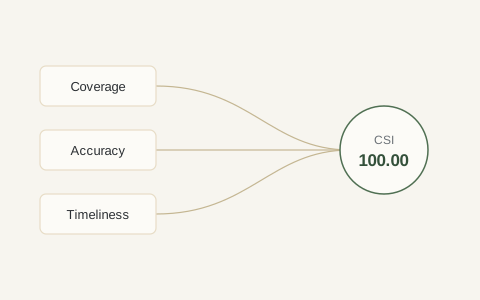
CSI methodology.
CSI is built from weighted, normalised metric changes.
The index begins at 100. Each metric update is normalised against a baseline, multiplied by a weight and adjusted by a direction factor.
Every CSI metric has a baseline, weight and direction factor. A rise in an animal-agriculture pressure indicator can lower the CSI. A decline can raise it. Production publication would also require validation, anomaly review, reconciliation, exact source identity and rights clearance.
Direction factors make reductions legible.
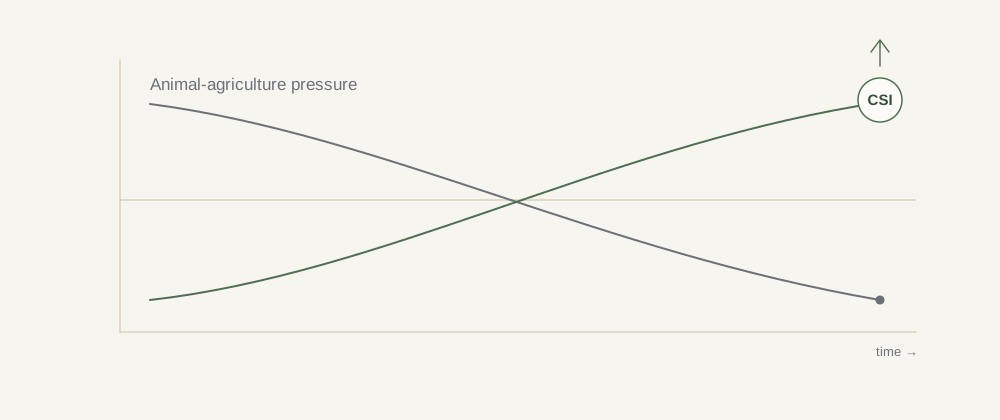
Most CSI metrics represent animal-agriculture pressure. When livestock population, emissions, feed production or land use rise, the direction factor can reduce the index. When those pressures fall, the same mechanism can lift the index.
- CSI_t
- Composite Sustainability Index value at the current update.
- w_i
- Normalised weight assigned to metric i.
- D_i
- Direction factor that determines whether a metric rise helps or hurts the index.
- M_i,0
- Baseline value for metric i.
The csi-v1.1.0 constants, as the engine loads them.
The recorded candidate methodology is csi-v1.1.0 (engine methodology hash sha256:4eeec13bdb90c15fffc0a0ae73cbc8e42b771dc9b2e79ae6efb4de3109ef904d, the hash of the canonical methodology material, not of a file). The index base is 100 with bounds 0 to 200; the weight denominator is 101; output is E8 fixed point. Global confidence constants: minimum final snapshot confidence 0.80, minimum metric confidence 0.75, minimum provisional snapshot confidence 0.65, minimum available weight for a provisional snapshot 0.80, cross-metric maximum contradiction ratio 0.33. Every metric shares relative bounds of -1 to +1, minimum raw source coverage 0.50 (target 0.90), an agreement tolerance of 0.03 of baseline, an anomaly window of 24 epochs and an anomaly z-threshold of 6. Only two metrics differ from csi-v1.0.0: trade (per-epoch cap 0.050 to 0.100, baseline window re-anchored to 2018-2022) and consumer transition (smoothing 0.40 to 0.50, per-epoch cap 0.050 to 0.030). These constants define a calculation; they do not authenticate current source observations.
| Metric id | Raw weight (of 101) | Direction | Smoothing lambda | Per-epoch cap (of baseline) | Relative bounds | Min sources |
|---|---|---|---|---|---|---|
| g20_livestock_population | 25 | -1 | 0.70 | 0.030 | -1 to +1 | 2 |
| animal_agriculture_ghg | 20 | -1 | 0.60 | 0.030 | -1 to +1 | 2 |
| animal_agriculture_land_use | 15 | -1 | 0.60 | 0.020 | -1 to +1 | 2 |
| animal_product_trade | 10 | -1 | 0.40 | 0.100 | -1 to +1 | 2 |
| livestock_feed_production | 10 | -1 | 0.50 | 0.040 | -1 to +1 | 2 |
| animal_product_output | 10 | -1 | 0.50 | 0.040 | -1 to +1 | 2 |
| animal_agriculture_employment | 7 | -1 | 0.70 | 0.020 | -1 to +1 | 2 |
| consumer_transition_score | 4 | +1 | 0.50 | 0.030 | -1 to +1 | 2 |
How the illustrative series is constructed.
The calculation record declares two layers. Its 2000-2023 base references a FAOSTAT annual record at WORLD scope, with World Bank, ILO and Climate TRACE feeds declared for employment and emissions. Its 2024-2026 display is labelled as a nowcast splice from the national collectors listed in Global Optics. These declarations explain the model input boundary; they do not establish authenticated production ingestion or completed rights review.
Two construction choices should be read with the numbers. The land-use sub-index measures FAOSTAT permanent meadows and pastures (RL item 6655, element 5110) at WORLD scope only, so it is blind to feed cropland; the land-use sub-index page documents what it measures, what it omits and the proposed ADR-016 change on the csi-v1.2.0 track. The consumer-transition sub-index is built from pooled national blocs on official price statistics (the csi-v1.1.0 redefinition), not from a single global survey. Every sub-index is SubIndex = 100 + 100 x D x y_bar, with y_bar the bounded relative deviation from its baseline, and the CSI is the weighted average over 101; the direct raw-to-CSI formula is retained as the E8 parity verifier.
The reference value is a published model output.
The reference value is derived from the CSI, not from a live market price. It uses constant CSI elasticity, so a 1 percent move in CSI is about a lambda_C percent move in the reference value. There is no value floor: P_fund_min is only a small safety floor that keeps ratios defined near zero, not a redemption value. It is defined as a ratio of the base normalisation, P_fund_min = epsilon_fund times P0, so the floor stays scale-invariant if P0 ever moves off 1.0. At CSI 100 the figure is P0, and it falls multiplicatively as the CSI falls. It is a transparency signal, not a price guarantee, redemption right or appreciation promise, and the CSI never changes user balances in v1.
P_fund = max(P_fund_min, P0 times (CSI / 100) to the power lambda_C), with P0 = 1.0, lambda_C the CSI exposure elasticity (interim default 0.60) and P_fund_min = epsilon_fund times P0 (interim epsilon_fund = 0.01). At the provisional CSI 76.16 the reference value is 0.8492. This is the same model (reference model constant_elasticity_v1) the tokenomics page states and the CSI engine computes (ADR-008). The canonical reference updates only on a certified, final CSI snapshot; provisional CSI drives a display estimate only. The wider pipeline is CSI_meas to CSI_ref to P_fund to the observe-only control anchor P_ctrl.
- P0
- Base reference normalisation, 1.0 in v1. Not a guaranteed price.
- lambda_C
- CSI exposure elasticity, calibrated by simulation and governance; 1.00 full exposure, 0.60 damped (interim default), 0.00 observe-only.
- P_fund_min
- A small positive safety floor that keeps ratios and gap metrics defined near zero, defined as the ratio epsilon_fund times P0 so it stays scale-invariant. Not a value or redemption floor; interim, calibration-pending.
- epsilon_fund
- The safety-floor ratio against P0 (0 < epsilon_fund << 1; interim 0.01). The floor P_fund_min is epsilon_fund times P0, not a naked constant.
- CSI_ref
- The certified (final, controller-eligible) CSI. Provisional or disputed CSI holds the last certified value for the canonical reference.
- Reserves and liquidity
- Shape the controller damping (Omega) and bands, never the reference value, to avoid reflexive feedback.
Validation protects the index from bad inputs.
Every update runs through the same pipeline before it can move the index. Each stage is inspectable on its own, and an update only counts once it has cleared them all.
- 1
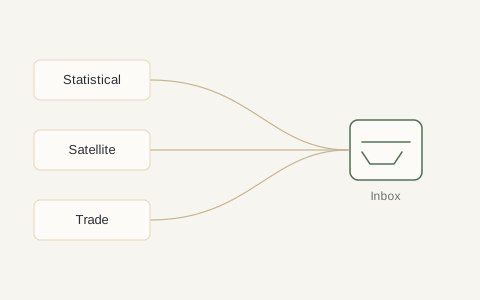
Source ingestion
Data arrives from trusted statistical, research, satellite, market or administrative sources.
- 2
Format checks
The system rejects missing fields, impossible values and malformed reporting periods.

- 3
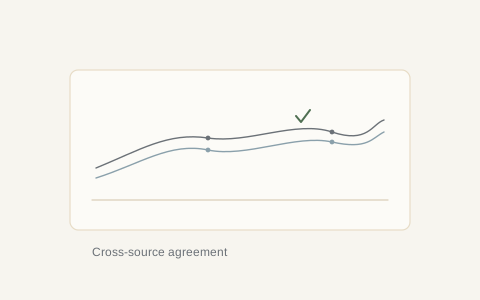
Cross-source checks
The system compares each metric with related indicators and alternative sources.
- 4
Anomaly detection
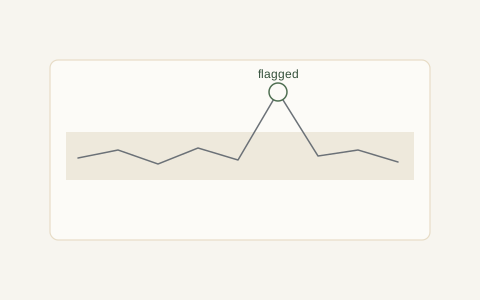
Controls flag unusual spikes, drops and unexplained patterns.
- 5
Manual review
A review process investigates unresolved anomalies before publication.

- 6
CSI update
Confirmed data updates the relevant sub-index and consolidated CSI.